


AI is everywhere – ChatGPT, Perplexity, Copilot, Gemini – you name it and here’s the big shift: over 50% of first-hand discovery will soon move from traditional search engines to AI-powered platforms. (Source: Gartner)
That means people will “ask AI” instead of “Googling it,” and if your brand isn’t AI-compliant, it might never show up in those answers.
What Does “AI-Compliant” Mean?
Simply put, your website should be LLM-readable. Large Language Models (LLMs) like ChatGPT or Perplexity pull information from multiple places, not just Google. They rely on:
- Search engine indexes (Google, Bing)
- Public web crawlers (Common Crawl, Wikipedia, news, forums)
- Structured data (schema markup, feeds, reviews, FAQs)
If your content isn’t accessible or understandable to these sources, AI platforms might skip your brand entirely.
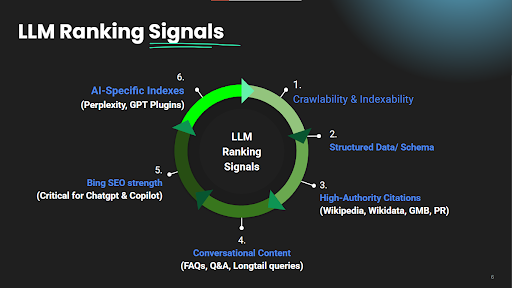
Getting Future-Ready: Here’s How We’re Evolving
Indexability & Crawling
This means making sure Google and other search engines can find and read every page of your website.
- We check that no important page is “hidden” from Google.
- We keep the sitemap updated, which is like a map that shows all the pages of your site.
- We make sure your website is verified on Google Search Console and Bing Webmaster Tools – these tools tell us how search engines see your site and if there are any issues.
In short, this step ensures your website is visible and accessible to all search engines.
Schema Markup
This is a small piece of code added to your website that helps search engines and AI tools understand your content better. For example:
- If you have a product, it tells Google the price, reviews, and availability.
- For FAQs, it tells AI tools which are the questions and which are the answers.
- For business info, it tells where you’re located, your contact info, and what you do.
In short, schema helps AI and Google “read” your website the smart way: not just words, but what they mean.
AI-Optimized Content
This is about writing your website content in a way that AI tools (like ChatGPT or Gemini) can easily pick it up and use it to answer user queries. We do this by:
- Turning long paragraphs into clear Q&A formats.
- Using conversational, easy-to-understand language (the way people ask questions to AI).
- Making sure your pages answer specific user intents, and not just keywords.
In short, we make your website AI-friendly, so it shows up when someone asks AI tools about your brand or topic.
AI Traffic Tracking
Just like we track traffic from Google or Instagram, we’ll also start tracking visits coming from AI tools, like ChatGPT, Perplexity and others. We’ll set up analytics to:
- See how many users are visiting from AI platforms.
- Understand which content is performing well in AI-driven search.
In short, this helps us measure how well your brand is doing in the new world of AI discovery.
What’s Next: Taking it to the Next Level
1. High-Authority Citations
This means making sure your brand is listed on trusted, well-known platforms, like:
- Wikipedia / Wikidata – tells AI your brand is authentic and notable.
- Crunchbase / LinkedIn – confirms your company details, team, and background.
- Major news sites – add credibility with third-party mentions.
These listings act as “trust signals” just like a blue tick for your brand.
In short, the more trustworthy sources mention your brand, the more AI tools believe your information is accurate and credible.
2. AI-Specific Indexes
AI tools like Perplexity and ChatGPT are building their own databases (separate from Google). By joining:
- Perplexity’s Publisher Program – your website content can appear directly inside Perplexity’s answers.
- ChatGPT Plugins or Integrations – your brand can be visible when users search or shop using ChatGPT.
In short, this step makes sure your brand isn’t just visible on Google but also inside AI platforms that people are starting to use for search.
3. Bing + ChatGPT Optimization
ChatGPT and Microsoft Copilot get most of their data from Bing. So, by improving your Bing SEO (title tags, meta descriptions, schema, backlinks, etc.), you are actually increasing your chances of being mentioned by AI-powered search results.
In short, optimizing for Bing = better visibility in ChatGPT and Copilot answers.
4. Conversational Content Expansion
People no longer search just with keywords – they ask questions naturally, like:
- “What’s the best fitness program in Mumbai?”
- “How much does solar panel installation cost?”
We create and optimize content that matches this conversational tone and covers long-tail questions (detailed, specific queries). In short, this helps your brand appear in AI-generated answers when people talk to AI tools the way they talk to humans.
The Future of Search is All About AI
AI is changing the way people find things online. When we make websites AI-friendly, we’re not just improving how they show up on Google today. We’re getting them ready for how search will work tomorrow. Our team is already using smart AI-based methods to ensure every bit of content we create is easy to find and relevant for users.
Want your website to be ready for the future of search?
Talk to our experts today and get your brand future-proof with AI.
FAQs: AI-Compliant Websites & AI-Driven Search
1. What does it mean for a website to be AI-compliant?
AI-compliant means your website’s content is structured and accessible in a way that Large Language Models (LLMs) like ChatGPT, Perplexity or Copilot can read, understand and reference accurately.
2. Why is AI-compliance important for my website?
AI-powered platforms are becoming the first point of discovery. Websites that aren’t AI-compliant may miss out on traffic, leads and brand visibility.
3. How can I make my website AI-compliant?
Key steps include:
- Ensuring all pages are crawlable and indexed by search engines
- Adding structured data like FAQs, product info and reviews
- Rewriting content in Q&A or conversational formats
- Tracking AI-driven traffic to understand performance
4. Will AI-compliance affect my traditional SEO?
Yes, but positively. Many AI-friendly practices, like schema markup and quality content, also improve your search engine rankings.
5. Which AI tools are most relevant for website compliance right now?
ChatGPT (powered by Bing), Perplexity, Copilot and Gemini. Optimizing for Bing SEO and exploring AI-specific indexes like ChatGPT Plugins can directly enhance visibility.
6. How do I track if AI is driving traffic to my website?
Set up analytics to monitor traffic from AI-driven search tools like Bing Chat, ChatGPT or Perplexity. This helps measure how AI discovery impacts your site’s performance.